Commitments in detail
Each commitment, in detail
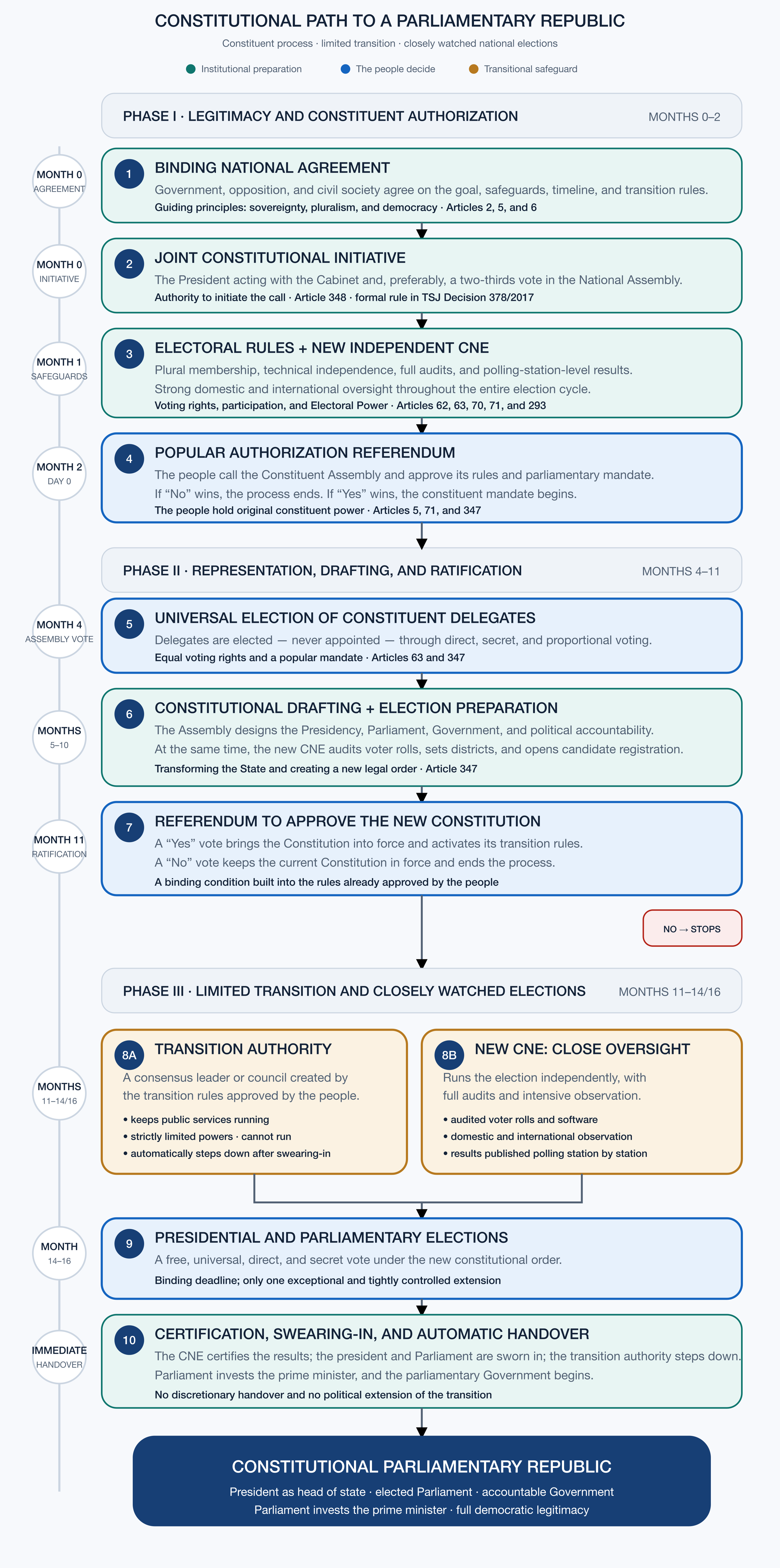
01Popular authorization to initiate the constituent processLearn the details
- Purpose
- Through a consultation, the people authorize convening the constituent process and approve its rules and mandate.
- Commitment sought
- Legitimacy of origin: the process advances only if the people authorize it.
- Constitutional or legal foundation
- Constitution of the Bolivarian Republic of Venezuela, articles 5, 70, 71, 347, and 348. Constitutional Chamber Decision 378/2017 is considered only within its precise limits and not to justify a transformation without popular participation.
- Proposed responsible participants
- The Venezuelan electorate; a new independent electoral authority; the parties convening the accord.
- Proposed timing
- Early stage of the process, per the proposed timeline.
- Verification and reporting
- Accredited domestic and international observation, audit of the registry, and publication of results by polling station.
- Legal or operational limitations
- The authorization consultation does not replace the later ratification of the new Constitution. Its content and timing remain subject to the parties' agreement.
Status: for consideration and subject to agreement← Back to the ten commitments
02Direct election of constituent delegates and drafting of the new ConstitutionLearn the details
- Purpose
- The constituent delegates are elected directly by the people and draft a new constitutional order.
- Commitment sought
- A Constitution drafted by elected delegates, not appointees.
- Constitutional or legal foundation
- Constitution, articles 63 and 347 (direct, secret, and proportional vote; transformation of the State and a new legal order).
- Proposed responsible participants
- The elected constituent delegates; the new electoral authority; universities and specialists in a technical-support capacity.
- Proposed timing
- Following popular authorization, per the proposed timeline.
- Verification and reporting
- Audited and observed election; sessions and records open to the public.
- Legal or operational limitations
- The draft Constitution does not take effect until popular ratification. Institutional design rests with the elected delegates.
Status: for consideration and subject to agreement← Back to the ten commitments
03Popular ratification, limited transition, supervised elections, and automatic handoverLearn the details
- Purpose
- The people ratify the new Constitution by referendum; a limited transition leads to elections and the automatic handover of power.
- Commitment sought
- That the new Republic arise from the people's direct ratification.
- Constitutional or legal foundation
- Constitution, articles 5, 71, 333, and 350, and the transitional provisions of the new Constitution; article 328 (the nonpartisan character of the National Armed Force).
- Proposed responsible participants
- The electorate; a transitional authority with expressly limited powers; the electoral authority.
- Proposed timing
- Second half of the process, per the proposed timeline; installation anticipated, if approved, around January 2028.
- Verification and reporting
- Audited referendum; observed elections; automatic termination of the transitional authority upon the swearing-in of the elected authorities.
- Legal or operational limitations
- The transitional authority may not extend itself or alter the popular mandate. The dates are proposals subject to agreement.
Status: for consideration and subject to agreement← Back to the ten commitments
04Political peace, nonviolence, and democratic guaranteesLearn the details
- Purpose
- A mutual renunciation of violence and the constitutional and electoral resolution of differences, without collective reprisals.
- Commitment sought
- An environment that allows negotiation and decision without coercion.
- Constitutional or legal foundation
- Constitution, articles 2 and 3 (the democratic State and its aims) and 350 (defense of the democratic order).
- Proposed responsible participants
- The parties invited to the accord; accredited observers.
- Proposed timing
- From the outset of the process and throughout its execution.
- Verification and reporting
- Verifiable commitments, accredited observation, and public reporting.
- Legal or operational limitations
- Guarantees are defined by the parties' agreement and do not imply general amnesties or any waiver of victims' rights.
Status: for consideration and subject to agreement← Back to the ten commitments
05Immediate and independently verified release of political prisonersLearn the details
- Purpose
- Release of persons arbitrarily detained for political reasons, through an independent verification mechanism.
- Commitment sought
- Restoration of rights as a verifiable sign of good faith.
- Constitutional or legal foundation
- Constitution, articles 44 (personal liberty), 49 (due process), and 23, 29, and 30 (human rights and their protection).
- Proposed responsible participants
- An independent identification and monitoring mechanism. The participation of Foro Penal is proposed, subject to its acceptance and full respect for its autonomy.
- Proposed timing
- Among the first commitments of the process.
- Verification and reporting
- Case-by-case review, continuous monitoring, and public verification of compliance.
- Legal or operational limitations
- Scope and procedures are defined by agreement, with full respect for the independence of the participating organizations.
Status: for consideration and subject to agreement← Back to the ten commitments
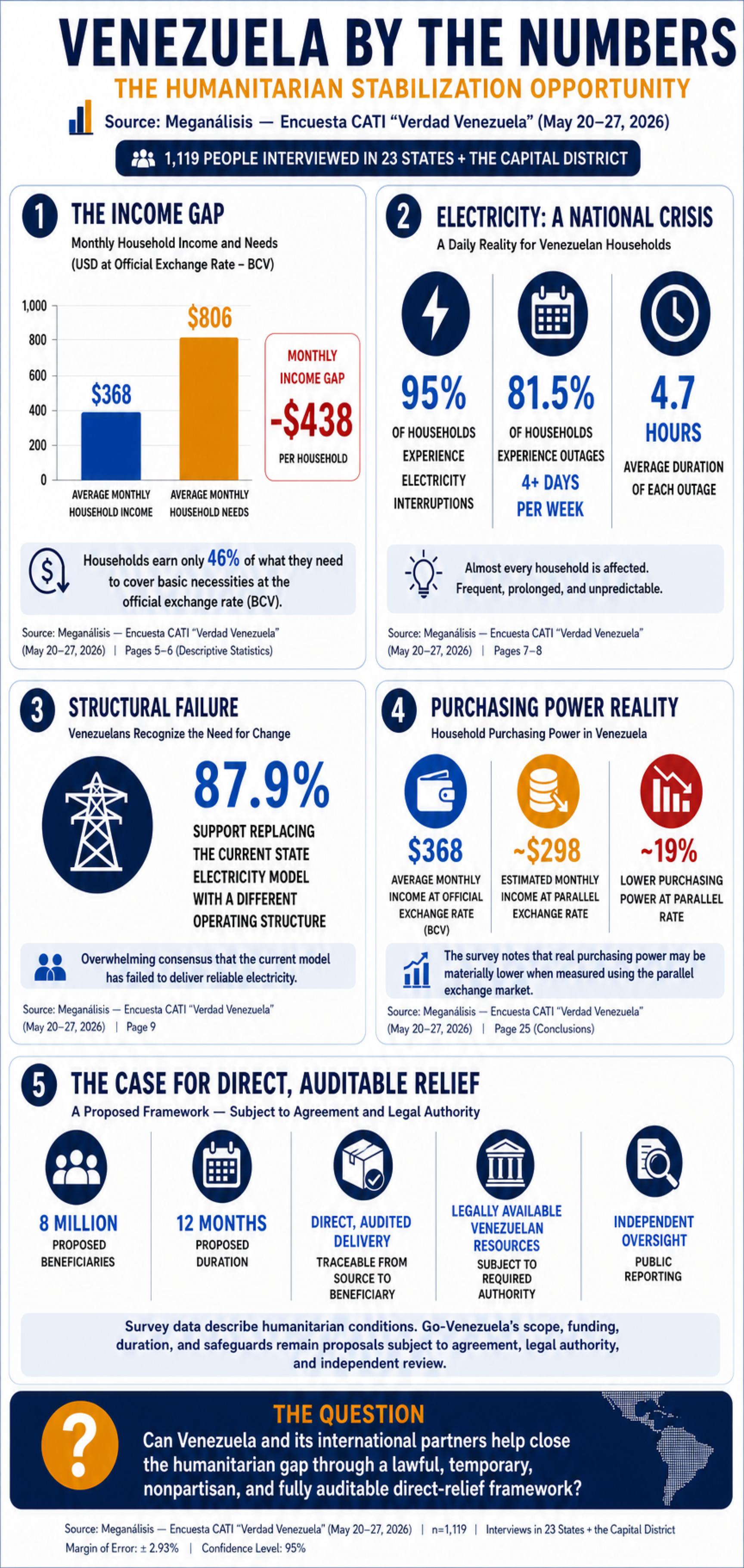
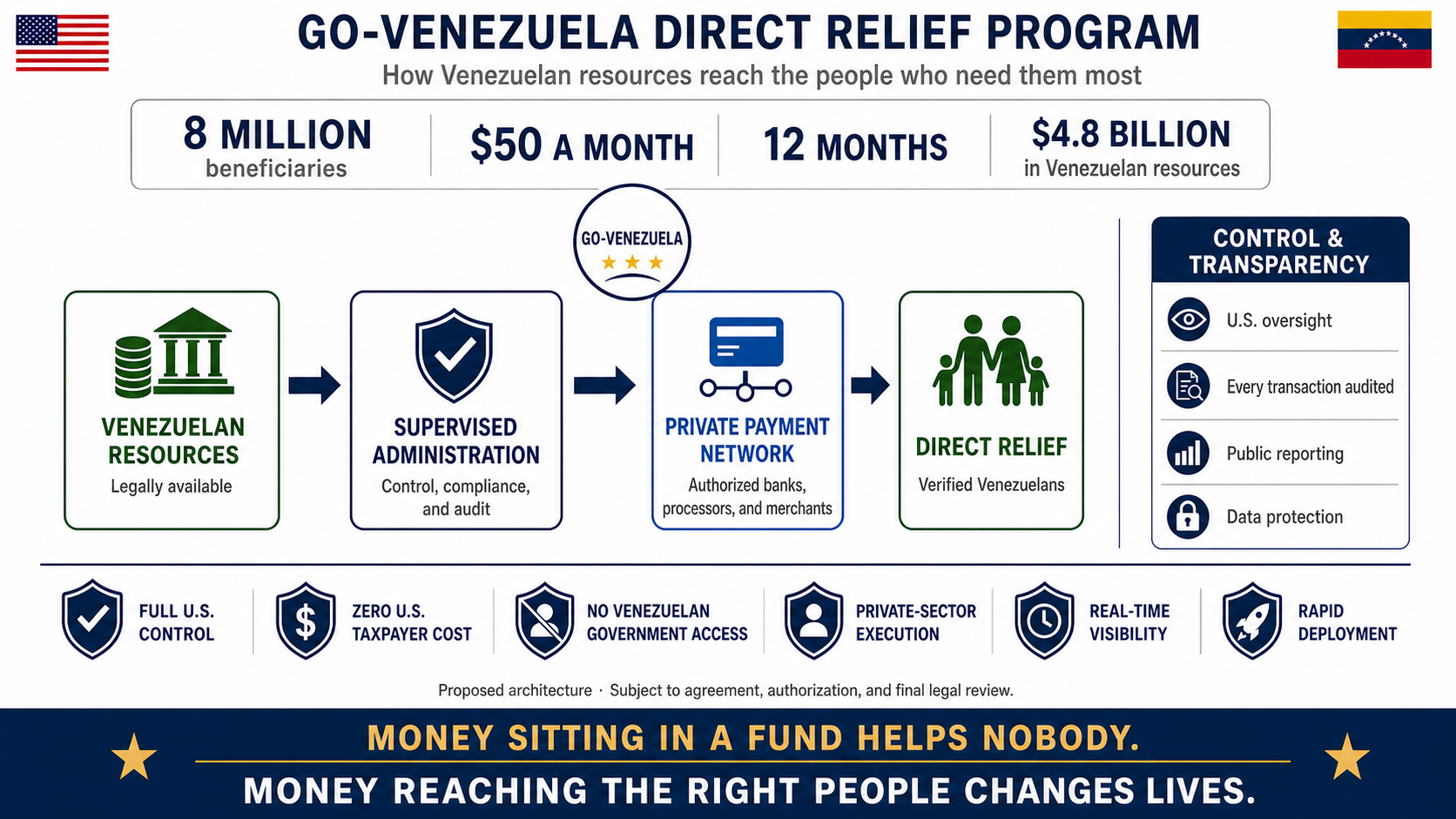
06Immediate relief and humanitarian stabilization through Go-VenezuelaLearn the details
- Purpose
- Direct, temporary, nonpartisan, and audited economic assistance, funded with legally available Venezuelan resources.
- Commitment sought
- Immediate relief for the families who need it most.
- Constitutional or legal foundation
- Legally available Venezuelan resources. As a reference framework, under review: U.S. Executive Order 14373 (custody of Venezuelan oil revenue) and the applicable OFAC authorizations.
- Proposed responsible participants
- An audited administration of the fund and independent oversight. The definitive structure remains subject to qualified legal review.
- Proposed timing
- Proposed to begin at an early stage of the process, per the timeline.
- Verification and reporting
- Mandatory oversight and auditing; public reporting.
- Legal or operational limitations
- Amounts, duration, and payment mechanisms would be defined in a binding operational protocol. No per-person amounts are committed in this document.
Status: for consideration and subject to agreement← Back to the ten commitments
07A new independent, audited, and closely supervised electoral authorityLearn the details
- Purpose
- A new National Electoral Council, plural and technically competent, with an audited registry and accredited observation.
- Commitment sought
- Credible elections with results verifiable by polling station.
- Constitutional or legal foundation
- Constitution, articles 292 and 293 (Electoral Power) and 62, 63, and 70 (participation and suffrage).
- Proposed responsible participants
- A new National Electoral Council; accredited domestic and international observers.
- Proposed timing
- Formation at an early stage, per the proposed timeline.
- Verification and reporting
- Audited registry, accredited observation, and results published by polling station.
- Legal or operational limitations
- Composition and rules are defined by agreement, with independent auditing at every phase.
Status: for consideration and subject to agreement← Back to the ten commitments
08Truth, justice, reparations, reconciliation, and protection against collective political persecutionLearn the details
- Purpose
- A lawful, temporary, and independent system that recognizes victims and determines individual responsibility with due process.
- Commitment sought
- Future coexistence without impunity or vengeance.
- Constitutional or legal foundation
- Constitution, articles 29 and 30 (victims' rights and reparations) and 49 (due process).
- Proposed responsible participants
- An independent system created after the installation of the new Republic, with international standards as a reference.
- Proposed timing
- Once the elected institutions are installed.
- Verification and reporting
- Public procedures, with due process and individual responsibility.
- Legal or operational limitations
- No collective responsibility or general amnesty is contemplated, and no individual case is prejudged.
Status: for consideration and subject to agreement← Back to the ten commitments
09Preliminary Venezuela–United States cooperation frameworkLearn the details
- Purpose
- A preliminary framework in security, energy, investment, custody of assets, and reconstruction, within each party's powers.
- Commitment sought
- Support for stabilization without replacing Venezuelan sovereignty.
- Constitutional or legal foundation
- Constitution, articles 152, 153, 154, and 187.18 (international relations and legislative approval). U.S. reference instruments, under review: Executive Order 14373, OFAC general licenses, and the Foreign Sovereign Immunities Act.
- Proposed responsible participants
- Subject to acceptance and applicable powers, the participation of the Executive Branch and the bipartisan presence of members of the United States Congress, as witnesses and observers, would be requested.
- Proposed timing
- A preliminary framework during the process; definitive instruments to follow.
- Verification and reporting
- Review by the future elected Venezuelan Parliament and by the competent constitutional authorities of the United States, each according to its own procedures.
- Legal or operational limitations
- The preliminary framework does not eliminate the constitutional authority of the future Venezuelan Parliament or the applicable U.S. constitutional process. Cooperation does not replace Venezuelan sovereignty.
Status: for consideration and subject to agreement← Back to the ten commitments
10Venezuelan Investment and Recovery Fund · implementation calendar, verification, and complianceLearn the details
- Purpose
- An institutional vehicle to administer, transparently and under audit, the resources devoted to reconstruction, with verification at each stage.
- Commitment sought
- Protected resources and verifiable commitments.
- Constitutional or legal foundation
- A framework for the custody and protection of assets, under review: the Foreign Sovereign Immunities Act, OFAC authorizations, and Executive Order 14373, together with applicable Venezuelan law.
- Proposed responsible participants
- An audited and protected administration and independent oversight.
- Proposed timing
- Structuring during the process; operation per the implementation calendar.
- Verification and reporting
- Independent auditing, financial transparency, and public reporting at each stage.
- Legal or operational limitations
- The protective structure remains subject to applicable Venezuelan and U.S. law and to qualified legal review, and does not promise absolute immunity from legitimate creditor claims.
Status: for consideration and subject to agreement← Back to the ten commitments